
Insight · Industry Report
Top 10 Mistakes Investors Make When Planning a Disposable Syringe Manufacturing Plant
Planning a disposable syringe manufacturing plant? Learn the top 10 mistakes investors make in factory layout, GMP, cleanroom, utilities, sterilization, ISO 13485, CAPEX and operating cost planning.
Key Takeaway
Planning a disposable syringe manufacturing plant? Learn the top 10 mistakes investors make in factory layout, GMP, cleanroom, utilities, sterilization, ISO 13485, CAPEX and operating cost planning.
ArticleTop 10 Mistakes Investors Make When Planning a Disposable Syringe Manufacturing Plant
Planning a disposable syringe manufacturing plant is not only a machine purchasing decision.
It is a complete medical device manufacturing project involving factory layout, GMP compliance, ISO 13485 quality management, cleanroom design, utilities, sterilization, laboratory planning, validation documents, operating cost and long-term market access.
Many investors start the project by asking one simple question:
“How much does a syringe production line cost?”
This is an important question, but it is not enough.
A syringe factory can fail not because the machines cannot run, but because the project was planned incorrectly from the beginning. A wrong layout, missing laboratory, undersized utility system, poor cleanroom design or unclear validation responsibility can create expensive problems after installation.
Based on real medical device factory project discussions, here are the top 10 mistakes investors should avoid when planning a disposable syringe manufacturing plant.
1. Only Comparing Machine Prices
Many investors begin by comparing injection molding machines, syringe assembly machines, printing machines and packaging machines from different suppliers.
This is understandable, but it is also risky.
The lowest machine price does not always mean the lowest project cost. A syringe manufacturing plant also requires:
Cleanroom construction
Compressed air system
Chilled water system
Mold cooling
Power distribution
Raw material storage
Finished goods warehouse
QC laboratory
Sterilization planning
GMP documentation
Installation and validation support
If these items are not included in the early CAPEX planning, the final investment may be much higher than expected.
NovalineX Insight
A syringe factory should be evaluated by total project cost, not only machine cost. Investors should compare CAPEX, operating cost, compliance risk and expansion flexibility together.
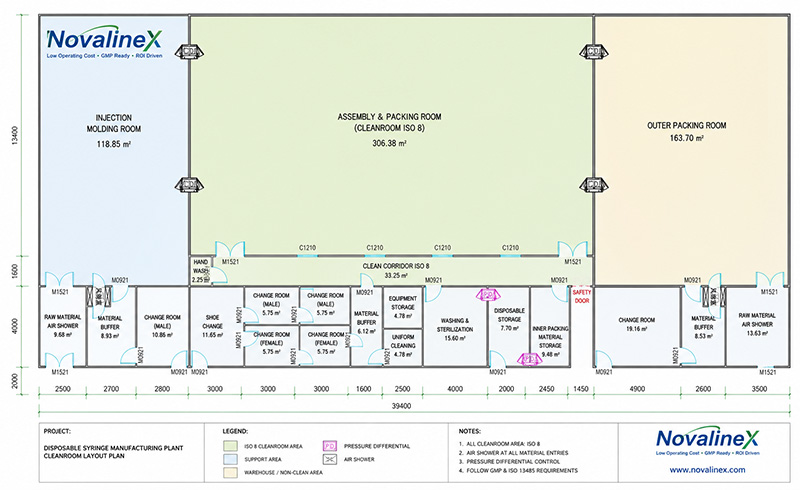
2. Underestimating Factory Space Requirements
A common mistake is planning the production area too tightly.
A disposable syringe factory needs more space than the production machines themselves. Investors must also consider:
Area | Why It Matters |
|---|---|
Injection molding area | Space for machines, molds, maintenance and material feeding |
Printing and assembly area | Usually requires cleaner environment control |
Packaging area | Must support smooth material and product flow |
QC laboratory | Required for quality inspection and release testing |
Raw material warehouse | For PP resin, needles, gaskets, packaging materials |
Finished goods warehouse | For sterile or non-sterile product storage |
Sterilization area | EO sterilization or outsourcing coordination |
Utility room | Air compressor, chiller, water system, power system |
If the factory is too small, material flow becomes chaotic, maintenance becomes difficult, and future expansion becomes expensive.
NovalineX Insight
For investors, factory layout should be planned based on product flow, personnel flow, material flow and future expansion, not only machine dimensions.
3. Designing the Cleanroom Too Late
Some investors treat cleanroom design as a later construction issue.
This is a serious mistake.
For syringe manufacturing, different processes may require different environmental control levels. Injection molding, printing, assembly and packaging do not always have the same cleanroom requirements. The final design depends on product type, regulatory target, market requirement and sterilization method.
Typical planning questions include:
Which processes should be inside the cleanroom?
Should injection molding be inside or outside the cleanroom?
What cleanroom grade is required for assembly and packaging?
How will air pressure, temperature and humidity be controlled?
How will personnel and material enter the clean area?
Where should airlocks and pass boxes be located?
If cleanroom planning is delayed, the factory layout may need to be redesigned.
NovalineX Insight
Cleanroom planning should start before finalizing the factory layout. A GMP-ready syringe factory must integrate cleanroom, HVAC, process flow and quality control from the beginning.
4. Ignoring GMP and ISO 13485 Requirements
A disposable syringe is a medical device. It is not just a plastic product.
Investors must consider quality management and regulatory requirements from the beginning, especially if they plan to sell to hospitals, government tenders or export markets.
Important compliance topics include:
ISO 13485 quality management system
GMP production environment
Batch traceability
Incoming material inspection
In-process quality control
Finished product testing
Sterilization validation
Equipment qualification
Document control
Corrective and preventive actions
If these requirements are not planned early, the factory may produce syringes but still fail registration or customer audit.
NovalineX Insight
A successful syringe factory should be designed as a GMP-ready medical device manufacturing plant, not just a plastic injection workshop.
5. Missing or Undersizing the QC Laboratory
Some investors focus heavily on production machines but forget the QC laboratory.
This is a major risk.
A syringe manufacturing plant needs quality inspection capability for raw materials, semi-finished products and finished products. Depending on the regulatory target, the laboratory may need equipment for:
Dimensional inspection
Leakage testing
Pull force testing
Sterility-related testing coordination
Particulate inspection
Packaging inspection
Visual inspection
Material verification
Product performance testing
Even if some tests are outsourced, the factory still needs an internal quality control area.
NovalineX Insight
The QC laboratory is not optional. It is part of the factory’s credibility. A syringe factory without proper QC planning will face serious audit and registration risks.
6. Underestimating Utility Systems
Machines cannot run reliably without proper utilities.
A syringe production line may require:
Stable power supply
Compressed air
Chilled water
Cooling tower or chiller
Mold temperature control
HVAC system
Vacuum system if required
Pure water or purified water if applicable
EO sterilization utilities if sterilization is in-house
A common mistake is selecting machines first and calculating utilities later. This may lead to insufficient air pressure, unstable cooling, poor cycle time, high energy consumption or frequent production stops.
NovalineX Insight
Utility planning should be part of the early project design. For a low operating cost syringe factory, energy consumption from injection molding, air compressors, chillers and HVAC must be calculated carefully.
7. Choosing Sterilization Method Too Late
Disposable syringes usually require sterilization before market release. Investors must decide early whether to use:
EO sterilization in-house
EO sterilization by outsourcing
Gamma sterilization by outsourcing
Other approved sterilization methods depending on market requirements
EO sterilization requires special planning for safety, ventilation, aeration, storage, environmental control and validation. It should not be placed randomly inside or near the main production area without proper engineering review.
If sterilization is outsourced, logistics, packaging compatibility, batch release timing and cost must be included in the project plan.
NovalineX Insight
Sterilization is not just a final step. It affects factory layout, packaging material, validation, production schedule and operating cost.
8. No Clear Responsibility for IQ, OQ and PQ
Many medical device factory projects become delayed because the responsibility for validation is unclear.
Key validation stages include:
FAT: Factory Acceptance Test
SAT: Site Acceptance Test
IQ: Installation Qualification
OQ: Operational Qualification
PQ: Performance Qualification
Machine suppliers can support FAT, SAT, IQ and OQ documents for their equipment. However, PQ, process validation, SOPs, VMP and regulatory submissions usually require involvement from the project owner, quality team and GMP consultant.
If this boundary is not clear, the investor may assume the supplier is responsible for everything, while the supplier assumes the owner will handle regulatory validation.
NovalineX Insight
Before signing the contract, investors should clearly define validation document scope and responsibility. This avoids disputes and delays during commissioning.
9. Planning for Current Capacity Only
Some investors design the factory only for the first production target.
For example, they may plan for one shift and one product size, but later want to add more syringe sizes, double shifts, more injection molding machines or automatic packaging.
If the original layout does not reserve space, power capacity, compressed air capacity and warehouse capacity, expansion becomes difficult and expensive.
A good syringe factory plan should consider:
Current capacity
Future capacity
Additional syringe sizes
Mold change strategy
Additional assembly machines
Extra packaging lines
Warehouse expansion
Utility expansion
NovalineX Insight
A bankable syringe manufacturing project should be designed in phases. Phase 1 should be cost-controlled, but the factory should still reserve space and utilities for Phase 2 expansion.
10. Ignoring Long-Term Operating Cost
Many investors calculate the initial investment but ignore long-term operating cost.
A syringe factory’s operating cost may include:
Electricity
Labor
Compressed air
Cooling water
HVAC
EO sterilization
Packaging material
Maintenance
Spare parts
Mold replacement
Quality testing
Waste management
A factory with lower CAPEX may become more expensive if it consumes too much energy, needs too much labor, or has high downtime.
NovalineX Insight
Investors should not only ask:
“How much does the syringe factory cost?”
They should also ask:
“How much will this factory cost to operate every year?”
This is why NovalineX focuses on low operating cost, energy efficiency, practical factory layout and ROI-driven project planning.
Summary: A Syringe Factory Is a Project, Not Just a Production Line
A disposable syringe manufacturing plant requires much more than machines.
To build a successful factory, investors must plan:
CAPEX
Factory layout
Cleanroom
GMP compliance
ISO 13485
QC laboratory
Utilities
Sterilization
Validation documents
Operating cost
Future expansion
The most expensive mistakes usually happen before the first machine arrives.
A well-planned project can reduce compliance risk, avoid layout changes, control operating cost and improve the chance of successful market entry.
How NovalineX Helps Investors Avoid Expensive Mistakes
NovalineX helps investors plan GMP-ready, ROI-driven medical device manufacturing projects for emerging markets.
We support investors with:
Disposable syringe production line planning
Factory layout concept
Cleanroom and utility planning review
CAPEX estimation
Equipment configuration
QC laboratory planning
GMP and ISO 13485 readiness support
Validation document boundary clarification
Low operating cost strategy
Bankable project package preparation
We do not only supply machines.
We help investors avoid expensive mistakes before they build the factory.
FAQ
How much does a disposable syringe manufacturing plant cost?
The cost depends on production capacity, syringe sizes, automation level, cleanroom scope, laboratory requirements, sterilization method, factory location and regulatory target. Investors should calculate both machine cost and total project CAPEX.
What machines are needed for syringe manufacturing?
A typical disposable syringe production project may include injection molding machines, molds, printing machines, assembly machines, packaging machines, air compressors, chillers, cleanroom systems, laboratory equipment and sterilization-related equipment or services.
Does a syringe factory need a cleanroom?
Yes, certain processes such as assembly and packaging usually require controlled cleanroom conditions. The required cleanroom level depends on the product, market and regulatory requirements.
Is ISO 13485 required for syringe manufacturing?
For most serious medical device markets, ISO 13485 is highly important and often required by customers, regulators or tender systems. It helps establish a quality management system for medical device manufacturing.
Should EO sterilization be done in-house or outsourced?
Both options are possible. In-house EO sterilization gives more control but requires higher investment, safety design, validation and operation management. Outsourcing reduces initial CAPEX but requires reliable logistics, batch control and cost planning.
Why do many syringe factory projects fail?
Many projects fail because investors underestimate cleanroom requirements, QC laboratory needs, utility systems, validation documents, operating cost and regulatory compliance. Machine purchasing is only one part of the project
if you're planning a new factory,read our complete guide to syringe manufacturing plant cost,covering investment,factory layout,utilities,ROI,and equipment selection.
About NovalineX
NovalineX helps investors develop bankable medical manufacturing projects across Africa, the Middle East, Asia, and emerging markets.
Interested in developing a medical manufacturing project?
Contact NovalineX for a preliminary project assessmentServices include
- Syringe Manufacturing Plants
- IV Solution Production Facilities
- Blood Collection Tube Projects
- GMP Planning
- ISO 13485 Compliance Support
- ROI & Feasibility Analysis
- Utility & Factory Layout Review
Next Step · Move Your Project Forward
Ready to advance your syringe factory project to bankable stage?
NovalineX delivers full bankability assessments, PPR preparation, GMP facility design, and turnkey production line execution — tailored to your market, scale, and financing plan.