
Insight · Industry Report
How to Build an AD and RUP Syringe Factory in Africa: 2026 Investment Guide
Planning an AD, RUP or conventional syringe factory? NovalineX can help you evaluate product selection, realistic capacity, factory layout, equipment configuration, utilities and production cost before major investment decisions are made. Contact us for a preliminary project assessment.
Key Takeaway
Planning an AD, RUP or conventional syringe factory? NovalineX can help you evaluate product selection, realistic capacity, factory layout, equipment configuration, utilities and production cost before major investment decisions are made. Contact us for a preliminary project assessment.
How to Build an AD and RUP Syringe Manufacturing Plant in Africa: A 2026 Investment Guide
Africa’s syringe manufacturing market is moving into a new phase.
The opportunity is no longer limited to replacing imported conventional disposable syringes. Governments, development institutions and healthcare procurement organizations are increasingly interested in locally manufactured safe injection devices, including auto-disable, or AD, syringes and reuse-prevention, or RUP, syringes.
This shift is supported by broader policies encouraging the local production of medicines and medical devices. The World Health Organization’s African regional framework for 2025–2035 specifically promotes stronger local manufacturing ecosystems for pharmaceuticals, medical devices and vaccines.
At the same time, UNICEF continues to procure large volumes of safe injection equipment. Its 2026–2027 procurement arrangements cover AD syringes, RUP syringes, conventional disposable syringes, insulin syringes, disposable needles and safety boxes.
For investors, however, this opportunity comes with an important warning: installing syringe machines is not enough.
A project must be designed around the intended market, product standard, regulatory pathway, production cost and procurement strategy from the beginning.
What Are AD and RUP Syringes?
An auto-disable syringe contains a mechanism that automatically prevents the device from being used again after a complete injection.
AD syringes are mainly associated with immunization programs. The most common product is the 0.5 ml fixed-dose vaccine syringe, although other sizes may be required for specific vaccination applications.
A reuse-prevention syringe also incorporates a mechanism that prevents repeated use. Unlike fixed-dose AD syringes, RUP syringes can be designed for general therapeutic injections in different sizes.
The main product categories are therefore:
Conventional single-use disposable syringes
Auto-disable syringes for immunization
Reuse-prevention syringes for curative injections
Insulin syringes
Safety-engineered syringes
Prefilled syringes for pharmaceutical applications
The product decision affects almost every part of the factory, including mold design, injection molding, component structure, assembly technology, inspection methods, packaging and regulatory approval.
Investors should avoid purchasing a conventional syringe production line and assuming it can later be converted easily into an AD or RUP syringe line. The locking mechanism, component tolerances and assembly process may require substantially different tooling and equipment.
Why Local Syringe Manufacturing Is Growing in Africa
Africa has historically depended heavily on imported medical devices. Long supply routes expose buyers to shipping delays, freight costs, foreign-exchange pressure and disruption during public-health emergencies.
Local production can provide several advantages:
Shorter delivery times for national immunization and hospital programs
Reduced dependency on overseas suppliers
Better responsiveness during disease outbreaks
Local employment and industrial capability
Potential access to regional markets
Improved coordination between syringe and vaccine supply
Kenya and Rwanda already demonstrate this direction.
Kenya’s Revital Healthcare became an important African producer of WHO-prequalified AD syringes. Rwanda opened an auto-disable syringe facility in 2025 with reported capacity of up to one million 0.5 ml syringes per day. The facility was presented as a way to serve immunization programs while reducing delivery time and logistics costs.
These examples do not mean that every African country should immediately build a very large AD syringe factory. They show that local manufacturing can work when capacity, quality certification, procurement and regional demand are aligned.
Start With Market Validation, Not Equipment Selection
The first phase of an AD or RUP syringe project should be commercial and regulatory validation.
Before determining machine capacity, investors should answer the following questions:
Who will purchase the syringes?
Is the target market public procurement, private hospitals or export?
Which syringe sizes are required?
Are fixed or detachable needles needed?
Are AD, RUP or conventional disposable products required?
What standards and registrations apply?
Is WHO prequalification commercially necessary?
What annual volume can the market realistically absorb?
What is the target ex-factory selling price?
Are long-term purchase commitments available?
This analysis should include the national immunization program, central medical stores, private distributors, hospitals, NGOs and neighboring export markets.
A government’s interest in local production does not automatically guarantee purchase orders. Investors should distinguish between general policy support and a measurable procurement commitment.
Whenever possible, the project should seek offtake agreements, framework purchasing arrangements or documented demand forecasts before finalizing the investment.
Understanding WHO Prequalification and UNICEF Procurement
UNICEF supplies quality-assured injection equipment for supported vaccination programs. For these programs, UNICEF supplies AD syringes to reduce the risk of contaminated-device reuse.
UNICEF procurement information states that relevant AD syringes and safety injection products must meet applicable performance, quality and safety requirements. Consequently, a factory targeting international immunization procurement must be designed for more than domestic product registration.
WHO prequalification is not simply a certificate attached to a machine.
It requires a compliant product, controlled manufacturing process, documented quality management system, appropriate testing, technical documentation and consistent production performance. Product approval also depends on the specific design and manufacturer.
This is why a project should define its regulatory pathway before selecting molds and assembly equipment.
A practical development strategy may include two stages:
Stage 1: Domestic and regional market entry
The factory begins with products that can be registered under applicable national or regional medical-device regulations. This can generate operating experience and initial revenue.
Stage 2: International procurement readiness
The manufacturer develops the technical file, validation evidence, quality system and product-specific documentation required to pursue higher-level procurement qualification.
The exact pathway depends on the product and target country. Early consultation with regulatory and quality specialists is therefore essential.
Main Sections of an AD or RUP Syringe Factory
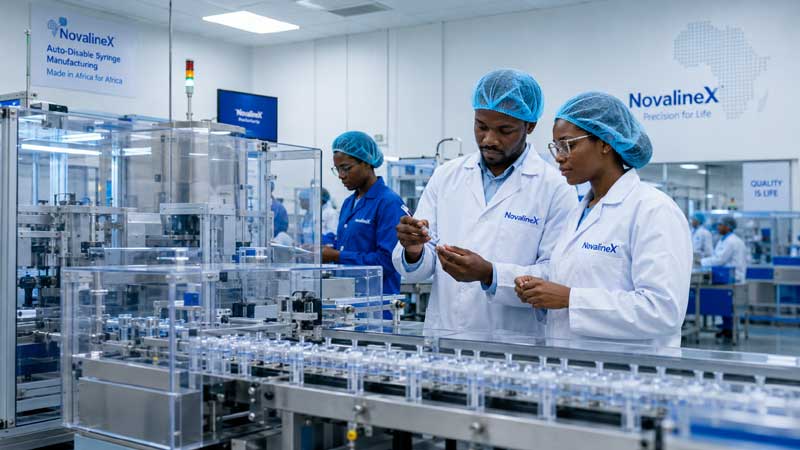
A complete syringe manufacturing facility usually includes the following production areas.
1. Plastic Injection Molding
Medical-grade polypropylene is used to manufacture components such as barrels and plungers. Depending on the syringe design, additional components may be required for the reuse-prevention mechanism.
The molding system may include:
Servo-driven injection molding machines
Multi-cavity syringe molds
Mold temperature controllers
Chillers and cooling-water systems
Material feeding and drying equipment
Oil-free or appropriately controlled compressed air
Component collection and transfer systems
Visual inspection equipment
Mold quality is critical. Poor cavity consistency can cause dimensional variation, leakage, assembly failure or activation problems in the safety mechanism.
2. Gasket and Plunger Assembly
Three-part syringes use an elastomeric gasket. The gasket must be assembled consistently without introducing contamination or excessive particles.
The material must also be compatible with the syringe’s intended use and applicable biocompatibility requirements.
3. Needle Production or Needle Sourcing
A manufacturer may produce needles internally or purchase qualified finished needles from an external supplier.
Internal needle manufacturing adds processes such as tube cutting, grinding, cleaning, siliconization, hub assembly and inspection. It can improve supply-chain control but also increases investment, technical complexity and validation requirements.
For a new factory, qualified external sourcing may reduce initial risk, provided that supplier controls and incoming inspection are properly established.
4. AD or RUP Syringe Assembly
The assembly machine must match the selected syringe design and locking mechanism.
Important controls can include:
Correct component orientation
Assembly force
Plunger travel
Lock activation
Dose accuracy
Needle attachment
Leakage prevention
Missing-component detection
Automatic rejection of defective products
A high nominal machine speed has little value if the line generates unstable output or excessive rejection.
5. Printing and Primary Packaging
Syringe barrels require accurate graduation printing. The product may then be packed in blister, film or medical paper-based packaging, depending on its design and sterilization method.
The packaging system must maintain seal integrity and permit the selected sterilization process.
6. Sterilization
The sterilization strategy must be selected during the project design stage, not after the packaging line has been ordered.
For many disposable plastic syringes, ethylene oxide sterilization is commonly considered. The project must evaluate sterilizer capacity, aeration, emissions control, residual testing, occupational safety and local environmental requirements.
Some manufacturers outsource sterilization during the initial phase. This can reduce capital expenditure, but only when a qualified sterilization provider is available and transportation does not compromise product control.
7. Quality-Control Laboratory
A syringe factory requires more than a small room with basic instruments.
The testing program may include:
Dimensional inspection
Graduation accuracy
Leakage testing
Plunger movement and break-loose force
Dead-space evaluation
Needle penetration and bond-strength testing
Locking or reuse-prevention function
Packaging seal integrity
Sterility testing coordination
Ethylene oxide residual testing
Bioburden and environmental monitoring
Raw-material and incoming-component inspection
The laboratory plan should reflect the product standard, regulatory requirements and tests that will be performed internally or outsourced.
GMP, ISO 13485 and Factory Layout
Syringe manufacturing projects are often described as “GMP factories,” but the design should be based on actual product and process risks rather than a generic cleanroom concept.
The layout should separate:
Raw materials
Injection molding
Component storage
Printing
Assembly
Primary packaging
Sterilization flow
Quarantine products
Released finished products
Rejected materials
Quality-control operations
Personnel and material movement
Cross-flows should be minimized. Environmental classification and monitoring requirements should be determined for each production step.
ISO 13485 is especially important because it provides the framework for the medical-device quality management system. Documentation may cover design control, supplier qualification, production control, nonconforming products, complaint handling, traceability, corrective action and risk management.
The quality system should be developed while the factory is being constructed—not after equipment installation.
How to Select the Right Production Capacity
One of the biggest risks in syringe factory investment is excessive capacity.
An investor may see a high-speed assembly machine as a sign of competitiveness. However, real annual output depends on the entire system:
Mold cycle time and cavity number
Number of injection molding machines
Assembly efficiency
Packaging capacity
Sterilization batch time
Maintenance downtime
Product changeovers
Quality rejection
Working days and shifts
Confirmed market demand
For example, a line with a nominal assembly speed of 18,000 syringes per hour will not deliver the expected annual volume if injection molding cannot supply balanced component quantities.
Production planning must therefore calculate the mass balance between barrel molding, plunger molding, gasket assembly, needle supply, final assembly, packaging and sterilization.
A modular approach is often more suitable for an emerging-market project. The factory can start with commercially supportable capacity and reserve space and utilities for expansion.
Calculate the Cost Per Syringe Before Investment
A bankable project requires a cost model rather than only an equipment quotation.
The cost per syringe may include:
Medical-grade polypropylene
Gaskets
Needles
Packaging materials
Sterilization
Direct labor
Electricity and cooling
Compressed air
Maintenance and spare parts
Quality-control testing
Cleanroom operation
Factory overhead
Depreciation
Financing cost
Product registration and certification
Logistics and distribution
The target cost should be compared with imported product prices on a like-for-like basis. Import duties, inland transport, distributor margins and foreign-exchange exposure should be considered.
Government preference for locally manufactured products can improve project viability, but the business should still be designed for competitive operation.
A Practical Implementation Roadmap
A well-structured AD or RUP syringe project can be divided into nine stages:
Market and procurement validation
Product definition and regulatory pathway
Capacity and financial feasibility study
Factory concept and utility planning
Equipment, mold and supplier selection
Quality-system and documentation development
Equipment FAT, installation and SAT
Process validation and product registration
Commercial launch and procurement qualification
Responsibilities must be clearly allocated among the investor, equipment supplier, cleanroom contractor, sterilization provider, regulatory consultant and validation partner.
The equipment supplier can support FAT, SAT, installation, training and equipment-related IQ/OQ documentation. Overall facility qualification, quality-system implementation, regulatory approval and final product release remain project-level responsibilities unless they are explicitly included in the contract.
How NovalineX Supports Syringe Factory Investors
NovalineX plans syringe manufacturing projects as integrated production systems rather than isolated machines.
Support can include:
Product and capacity definition
Production-line configuration
Factory layout coordination
Utility requirement planning
Equipment and mold integration
Cleanroom and workflow coordination
Cost-per-syringe calculation
ROI and sensitivity analysis
FAT and SAT coordination
Equipment installation and operator training
Equipment-related IQ/OQ documentation support
Coordination with GMP and regulatory partners
Expansion planning
This approach is particularly suitable for investors in Africa, the Middle East, Asia and Latin America who are establishing their first medical-device factory.
Conclusion
The growth of local medical-device manufacturing creates a meaningful opportunity for AD and RUP syringe production in Africa. Nevertheless, the successful projects will not be those that simply install the fastest machines.
They will be the projects that connect confirmed demand, appropriate products, regulatory planning, controlled production, competitive cost and a realistic procurement pathway.
Investors should therefore begin with market validation and product strategy. Equipment selection should follow—not lead—the investment decision.
A properly planned syringe factory can strengthen local health security and develop regional manufacturing capability. A poorly planned factory can become an expensive collection of underutilized machines.
The difference lies in project integration.
FAQ
1. What is an auto-disable syringe?
An auto-disable syringe contains a mechanism that automatically prevents reuse after an injection. It is primarily used in immunization programs to reduce the risk of infection caused by contaminated-device reuse.
2. What is the difference between an AD syringe and an RUP syringe?
AD syringes are commonly designed for fixed-dose immunization applications. RUP syringes prevent reuse but may support a wider range of therapeutic injections and syringe sizes. The product design, assembly mechanism and regulatory pathway can differ.
3. Can a conventional syringe production line manufacture AD syringes?
Not automatically. AD syringes require a product-specific locking mechanism, corresponding molds, controlled component tolerances and compatible assembly technology. Conversion feasibility must be confirmed before equipment procurement.
4. Does an African syringe manufacturer need WHO prequalification?
It depends on the target market. National registration may be sufficient for certain domestic sales. Manufacturers targeting UNICEF-supported immunization procurement or similar international programs may need WHO-prequalified products and compliance with the applicable procurement requirements.
5. What equipment is needed for an AD syringe factory?
A typical project includes injection molding machines, syringe molds, material feeding and cooling equipment, AD syringe assembly machines, graduation-printing equipment, primary packaging, sterilization capacity or outsourced sterilization, laboratory equipment and clean manufacturing areas.
6. How much capacity should a new syringe factory install?
Capacity should be based on verified annual demand, product mix, shifts, molding output, assembly speed, packaging, sterilization and realistic operating efficiency. A modular factory with planned expansion is often safer than installing excessive capacity initially.
7. Is ISO 13485 required for syringe manufacturing?
ISO 13485 is the principal quality-management-system standard used by medical-device manufacturers. Its practical importance depends on local regulations and target markets, but it is strongly recommended for a factory seeking sustainable regulatory and export access.
8. How long does it take to establish a syringe manufacturing plant?
The schedule depends on factory construction, equipment lead time, molds, cleanroom installation, sterilization, validation and registration. Equipment delivery alone does not determine the commercial launch date; regulatory preparation should begin during project design.
About NovalineX
NovalineX helps investors develop bankable medical manufacturing projects across Africa, the Middle East, Asia, and emerging markets.
Interested in developing a medical manufacturing project?
Contact NovalineX for a preliminary project assessmentServices include
- Syringe Manufacturing Plants
- IV Solution Production Facilities
- Blood Collection Tube Projects
- GMP Planning
- ISO 13485 Compliance Support
- ROI & Feasibility Analysis
- Utility & Factory Layout Review
Next Step · Move Your Project Forward
Ready to advance your syringe factory project to bankable stage?
NovalineX delivers full bankability assessments, PPR preparation, GMP facility design, and turnkey production line execution — tailored to your market, scale, and financing plan.